
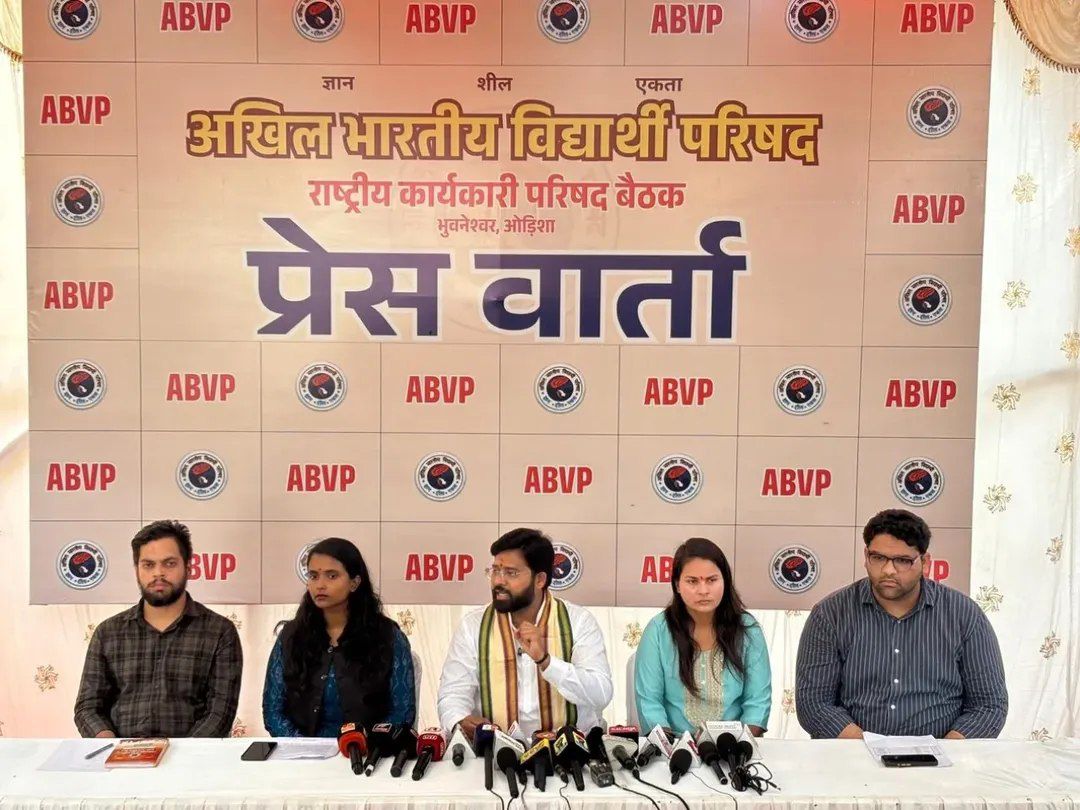
The National Executive Council (NEC) Meeting of Akhil Bharatiya Vidyarthi Parishad (ABVP) will be held from 29 to 31 May 2026 at Siksha ‘O’ Anusandhan University, Bhubaneswar, situated in the sacred land of Lord Jagannath. A total of 484 representatives from across the country will participate in the meeting, including ABVP national office bearers, student leaders from educational campuses across India, academicians, and representatives associated with various organisational dimensions and activities.
Prior to the NEC meeting, the Central Working Committee Meeting will be organised on 27 May, in which 106 karyakartas from across the nation are expected to participate. On 28 May, meetings of ABVP’s various dimensions, activities, and functional forums will be conducted. These meetings will include extensive discussions on year-long organisational activities, programmes, expansion plans, and future action plans. Reviews and future directions will be discussed regarding works being carried out in fields such as sports, arts, service activities, environment, research, medical education, agriculture, technology, tribal outreach, and international student engagement.
On the eve of the meeting, a “Civic Reception Ceremony” will be organised. Former and present ABVP karyakartas, eminent personalities from various walks of social life, academicians, and social leaders will participate in the programme. Hon’ble Chief Minister of Odisha, Mohan Charan Majhi, will attend the ceremony as the Chief Guest.
During the three-day National Executive Council Meeting, extensive deliberations will take place on the prevailing national scenario, education system, role of youth, national security, social and economic issues, organisational review and expansion, and contemporary challenges. The meeting will also review the outcomes of the “Akhil Bharatiya Vichar Baithak 2025” and deliberate upon the compilation and implementation of decisions taken during the “Sangathanatmak Vichar Baithak 2026”. Along with organisational, programmatic, and campaign-based reviews, the action plan for the coming year will also be finalised. Student union representatives and karyakartas from colleges and universities across the country will participate in discussions regarding ensuring student union elections in all educational institutions.
ABVP’s ongoing initiatives such as the “Screen Time to Activity Time Campaign”, “150 Years of Vande Mataram”, “Hostel Survey Campaign”, “Prof. Yashwantrao Kelkar Birth Centenary Year”, “50 Years of Resistance to Emergency”, “350 Years of the Sacrifice of Shri Guru Tegh Bahadur”, and the “650th Prakatyotsav of Sant Shiromani Ravidas Ji” will also be reviewed and future plans will be formulated. Discussions will further focus on organisational qualitative growth through membership expansion, campus unit formation, and innovative organisational experiments undertaken by various units. Targets for the coming year will also be determined after analysing these initiatives. Deliberations will additionally be held regarding National Conference 2026, SEIL Yatra, international student outreach, and future plans of various organisational dimensions. Resolutions concerning education, social issues, economy, national security, and youth-related contemporary concerns will also be passed during the meeting.
ABVP National General Secretary Dr. Virendra Singh Solanki stated, “This National Executive Council Meeting is an important milestone in determining the future direction of Vidyarthi Parishad in the context of present-day challenges and opportunities. Prominent ABVP karyakartas from all states of the country will participate in this meeting. After extensive deliberations on organisational, educational, environmental, economic, national security, and youth-related issues, important resolutions will also be passed. Every ABVP unit across cities and campuses will work on these subjects in the coming days. Organised in the culturally and spiritually vibrant city of Bhubaneswar, this meeting will emerge as a significant centre of organisational energy, ideological clarity, and programmatic expansion, further strengthening the power of students.”